
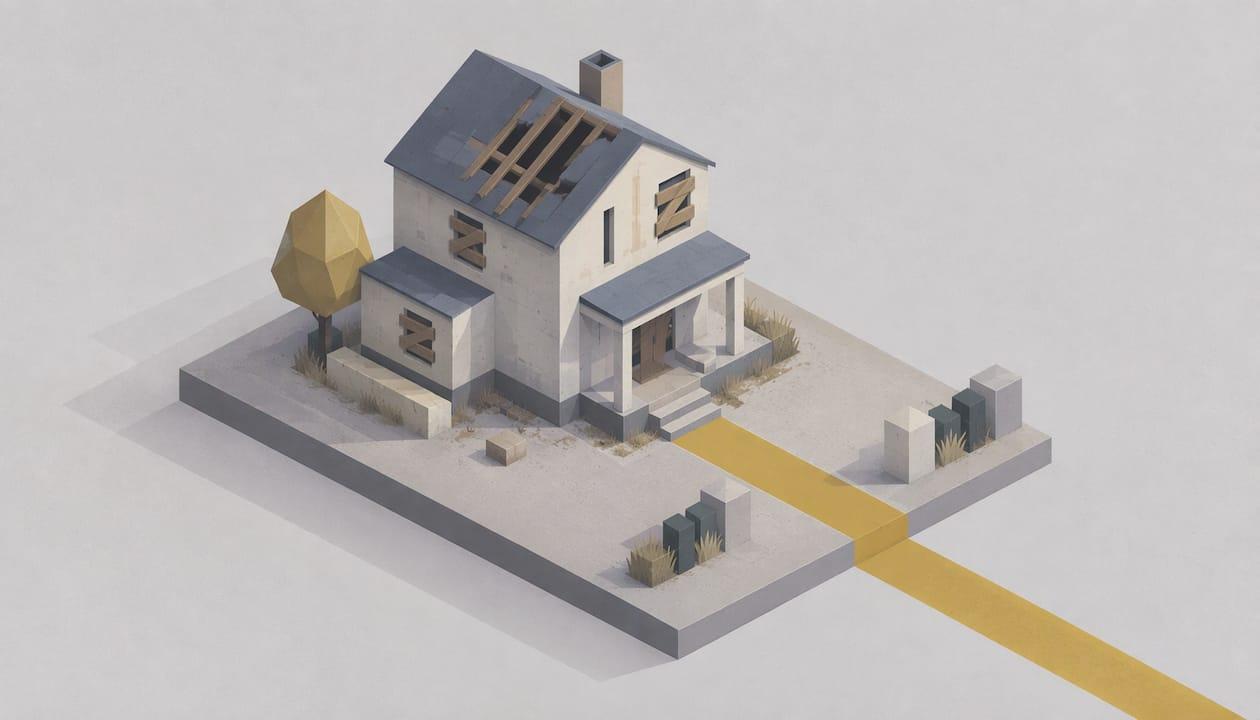
Yes, you can sell a condemned house. In most areas it is legal. The catch is who can buy it. Most lenders will not finance a home that is officially unsafe to live in, so your buyers are mostly investors, flippers and cash buyers. You also have to disclose the condemned status, and your city may add its own rules. We buy houses in any condition in Houston, San Antonio, Dallas, and other U.S. markets, and we make a cash offer within one business day. Offers are subject to inspection and transaction requirements.
This guide walks you through what "condemned" means, what to check with your city first, how buyers price these homes, and the routes you can take to sell.
TL;DR
- Selling a condemned house is legal in most areas, but the buyer pool is mostly cash buyers and investors.
- You must disclose the condemned status and known defects. Skipping that step can lead to lawsuits.
- Local rules differ. Some cities require a compliance certificate or a signed buyer acknowledgment before a transfer.
- Buyers price the lot first, then subtract demolition and repair costs and their own margin.
- We make a cash offer within one business day, with no fees, no commissions and no repairs required from you. Offers are subject to inspection and transaction requirements.
Table of Contents
- What "condemned" means for a sale
- Can you live in a condemned house while you sell it?
- Check your local rules before you list or sign anything
- What you must disclose to a buyer
- How a condemned house gets priced
- Your options for selling a condemned house
- Comparing the four routes
- What it looks like to sell your condemned house to us
- Our perspective
- Get a cash offer for your condemned house
- Practical tips before you decide
- Know someone with a condemned house?
- FAQ
- Sources
What "condemned" means for a sale
A condemned house is a property that local government officials have declared unsafe or uninhabitable. The home violates housing or building codes, or it has hazards that make it unfit to live in. Redfin describes the process of selling one as similar to selling a livable home, with two big differences: a much smaller buyer pool and strict disclosure duties.
Common reasons a house ends up condemned:
- Structural damage, such as a failing foundation or a collapsed roof
- Fire or flood damage that was never repaired
- Mold, sewage or other serious health hazards
- Long vacancy and neglect
- Unpermitted work that created safety problems
Condemnation is not the end of your rights. As PropertyChecker explains, an owner can still sell the property, appeal the condemnation within the stated timeframe, repair the home to bring it up to code, or rebuild on the lot if the home is demolished and local zoning allows it.
That means you have four basic paths:
- Appeal, if you believe the order is wrong and the deadline has not passed.
- Repair and clear the order, then sell a livable home.
- Demolish, then sell or build on the lot.
- Sell as-is to a buyer who will take on the work.
The rest of this guide helps you pick between them.
Can you live in a condemned house while you sell it?
No. A condemned property cannot legally be occupied until the problems are fixed and the order is lifted. According to PropertyChecker, the owner also cannot rent it out during that time.
If you are still living there, or a tenant is, talk to your city's code enforcement office right away. Ask what the order requires, how much time you have, and whether anyone has to leave by a certain date. Your safety and your household's safety come first. If you need help finding somewhere to go, your city or county housing office is the place to ask.

Check your local rules before you list or sign anything
There is no single national rule for selling condemned property. Cities and counties write their own codes. Here are real examples of how different they can be:
- Minneapolis, MN: you cannot buy, sell or work on a condemned building until it has a Certificate of Code Compliance. The city says that certificate shows the building was inspected, repaired to code, passed a final inspection and is safe to sell or occupy.
- Port Huron, MI: an owner who has received a compliance order cannot sell, transfer or mortgage the property until the order is complied with, or until the owner gives the buyer a copy of the order and a signed, notarized statement from the buyer accepting responsibility for the corrections. See the city code.
- Pennsylvania: under the state's Municipal Code and Ordinance Compliance Act, a buyer of a property known to be in violation generally has 12 months from purchase to bring it into compliance or demolish it.
- Freemansburg, PA: sellers or agents must schedule a borough inspection after listing, and violations that are found must be reported to the buyer and attached to the sale agreement under Ordinance 2009-032.
These are examples, not a map of every town. Texas cities, Georgia cities and Ohio cities all have their own versions. Before you sign a contract, do this:
- Get a copy of the condemnation or compliance order in writing.
- Ask code enforcement whether a transfer needs an inspection, certificate or buyer acknowledgment.
- Ask about deadlines, fines and appeal windows.
- Ask whether the city has demolition plans or liens on the property.
- Have a real estate attorney or title company read the order and any recorded liens before closing.
The attorney step matters most when the order carries a deadline or when the city has already started the demolition process.
What you must disclose to a buyer
Almost every state requires sellers to disclose known material defects, and condemned status is as material as it gets. Redfin notes that sellers should disclose the condemned status, the specific violations, structural issues and safety hazards. It also lists the risks of staying quiet: fraud lawsuits, breach of contract claims and financial penalties.
A clean disclosure packet usually includes:
- The condemnation or notice of violation, with its date
- Any inspection reports you have
- A list of known problems, such as roof, foundation, wiring, plumbing, mold
- Any open permits or unpermitted work you know about
- Any liens, fines or demolition orders tied to the property
Be specific. A buyer who has the full picture can make a fast decision. A buyer who finds surprises at closing will walk or renegotiate. Your state's rules on forms and wording differ, so ask a local attorney or title company which disclosure forms apply to your sale.
How a condemned house gets priced
Buyers do not price a condemned home the way they price a livable one. They start with the land.
U.S. News reports that a condemned house is typically worth 40% to 70% less than a comparable habitable home, and that the structure can be priced at zero or even negative value. The same article describes a buyer's opening number as roughly the lot's value, minus the cost to clear the site, minus a profit margin.
So your price depends on four things:
- What the lot is worth. Look at what vacant lots or teardown sales go for in your neighborhood.
- What it costs to clear. Demolition and debris removal.
- What else is wrong. Hazardous materials, liens, back taxes.
- How much risk the buyer carries. Time, permits and uncertainty.
No one can promise you a specific price before looking at the property. Any real offer is subject to an inspection and the terms of the transaction.
What demolition costs
Demolition is the biggest swing factor, so get a feel for the numbers. The figures below come from different sources and different methods, so treat them as ranges.
| Source | Typical range or average |
|---|---|
| HomeAdvisor | $6,000 to $25,000; most pay about $15,800 for a 2,000 sq ft home |
| Redfin cost guide | About $14,000 national average, at $4 to $10 per sq ft |
| U.S. News | $10,000 to $50,000 depending on size and materials; hazmat cleanup can add up to $20,000 |
One point from U.S. News is worth underlining. If the town demolishes the house, the bill can run as high as $50,000 and may be attached to the property as a lien. In that case you pay one way or another, either at the closing table or through a lien that follows the land. That is a strong reason to act before the city does, and to talk to your local code office about the timeline.
Your options for selling a condemned house
Option 1: Repair it, clear the order, and list it
If the damage is limited and you have the money, fixing the problems and getting the order lifted opens the door to regular buyers and mortgages. In some cities, such as Minneapolis, you need a compliance certificate to sell anyway. The trade-off is that you front the repair costs and the time. Repairs on a condemned home can grow quickly once inspectors open walls.
Buyers who want to finance a purchase plus repairs sometimes use an FHA 203(k) loan. HUD's handbook says this program insures lenders on loans used to buy and rehabilitate a one- to four-family home, with a minimum rehab cost of $5,000. A standard 203(k) also requires a HUD-roster consultant who inspects the property and prepares a work write-up and cost estimate. Whether a given condemned house qualifies depends on the lender and the condition of the home, so it is not something to count on.

Option 2: Demolish and sell the lot
Clearing the structure turns a hard-to-sell house into vacant land. Land is simpler for many builders and investors to price. You will need permits, a licensed contractor and a clear understanding of what zoning allows on the lot. You also carry the demolition cost up front, which is why many owners skip this route.
Option 3: List with an agent
An agent can list a condemned property, but expect a small buyer pool, long days on market and no mortgage buyers. You also pay commissions and closing costs, and you keep paying taxes, insurance and utilities while you wait. If you want to see what a standard agent-led process involves, this guide to selling a home in Seattle covers local pricing, preparation and offers from a brokerage point of view.
Option 4: Sell as-is to a direct cash buyer
This is the route we work on. A direct buyer purchases the house in its current condition, takes on the repairs or demolition, and handles the paperwork with you. There are no showings and no repair list. You do not pay commissions or fees to us. Closing timing depends on the title work, the city requirements and the details of your situation, so we never promise a date, though some sales can close in as little as 7 days.
Comparing the four routes
| Repair and list | Demolish and sell lot | List with agent | Sell as-is to cash buyer | |
|---|---|---|---|---|
| Upfront cost to you | High | High | Moderate | None for repairs |
| Who can buy | Anyone, including mortgage buyers | Builders, investors | Mostly cash buyers | Direct buyer |
| Repairs needed | All of them | Demolition | None, but harder to sell | None |
| Showings | Yes | Yes | Yes | No |
| Commissions | Yes, if listed | Yes, if listed | Yes | No |
| Time to sell | Long | Long | Unpredictable | Often faster |
What it looks like to sell your condemned house to us
We keep the process short and plain.
- Tell us about the property. Send the address, the condition, and a copy of any city notice you have. Photos help but are not required.
- We review it. We look at the home, the neighborhood, any orders and any liens.
- You get a cash offer within one business day. It is free and there is no obligation. Offers are subject to inspection and transaction requirements.
- You choose. Accept, decline or ask questions. Nobody pressures you.
- We handle the paperwork. We work through the title and closing steps with you, including the extra steps that city orders and liens can add.
- You pick the closing date that fits. Some sales close in as little as 7 days, depending on the transaction.
We do not charge fees or commissions, and you do not have to repair or clean the house first. If it still has furniture, junk or damage, that is fine.
Our perspective
Most owners of a condemned house come to us worn out. They have a city notice, a pile of repair estimates and no clear idea of what the house is worth. Our first job is to make the picture simpler.
We believe the house you have is the house you can sell. You should not have to put money into a property the city says nobody can live in just to find a buyer. That is why we buy as-is, in any condition, and why we take on the repairs, the cleanup and the paperwork ourselves.
We also think you deserve straight talk. A condemned house is priced on the land and on what it takes to make the site usable. We will explain how we got to our number, what orders or liens we see on the title, and what the closing will involve. We do not promise a price, a closing date or an outcome before we have looked at the property, and every offer is subject to inspection and transaction requirements.
If a city order has a deadline, call the code office and a real estate attorney as well as us. We will work with whoever you bring in. Our aim is that you leave the table with a clear answer and a fresh start, not a bigger problem.
Ammanuel
Get a cash offer for your condemned house
If you want an offer without repairs, showings or commissions, tell us about the house. We buy in Houston, San Antonio, Dallas, and other U.S. markets, and we make a cash offer within one business day. Offers are subject to inspection and transaction requirements.

Start with our cash offer page, or see how we work in Houston, San Antonio or Dallas. If you still owe on the house, our guide to selling a house with a mortgage explains payoff and net proceeds.
Practical tips before you decide
- Read every notice. Deadlines for appeals and repairs are short. Mark them on a calendar.
- Keep the taxes current if you can. Back taxes add to the list of things that must be settled at closing.
- Secure the property. An empty, damaged house attracts trespassers and more damage. Board up openings and keep the lot tidy.
- Do not hide the condition. Disclose the order and the defects. It protects you.
- Get more than one view. Ask for a demolition quote from a licensed contractor so you know what the buyer is subtracting.
- Talk to a professional. An attorney or title company can tell you what your city and state require.
Know someone with a condemned house?
If you know a neighbor, relative or client with a property like this, our referral program pays finders for leads that result in closed deals. Investors who want first look at off-market properties can join our buyer list.
FAQ
Can you sell a condemned house?
Yes, in most areas. The sale usually goes to investors or cash buyers, because lenders rarely finance condemned homes. You must disclose the condemned status and known defects. Some cities also require a compliance certificate or a buyer acknowledgment before a transfer, so check with your local code office.
Can you legally live in a condemned house?
No. A condemned home cannot legally be occupied or rented until the problems are fixed and the order is lifted. If people are still living there, contact your city's code enforcement office about the order and the timeline.
How much is a condemned house worth?
It is typically worth 40% to 70% less than a comparable livable home, according to U.S. News. Buyers start with the value of the lot, subtract the cost to clear it and add in their own margin. The actual number depends on the property, so no one can fix it in advance.
Who pays for demolition?
The owner is responsible for the home until it sells. Many cash buyers take demolition into account in their offer instead of asking you to pay first. If the city demolishes the house, the cost can be attached to the property as a lien.
How fast can you sell a condemned house for cash?
We make a cash offer within one business day, and some sales close in as little as 7 days. Timing depends on title work, city requirements and the transaction, so we never guarantee a closing date.
Sources
- Can you sell a condemned house? Redfin
- What is a Condemned Property and Can You Buy or Sell It? PropertyChecker
- Condemned Properties, City of Minneapolis
- Article IV: Transfer of Ownership, City of Port Huron, MI
- Municipal Code and Ordinance Compliance Act, Pennsylvania General Assembly
- Freemansburg Borough Ordinance 2009-032
- How to Buy or Sell a Condemned Home, U.S. News Real Estate
- How Much Does House Demolition Cost? HomeAdvisor
- How Much Does It Cost to Demolish a House? Redfin
- FHA Mortgagees' Handbook, HUD
- Processing a Mortgage for FHA Insurance, HUD
- How to Sell a House in Seattle, Fanus Homes