
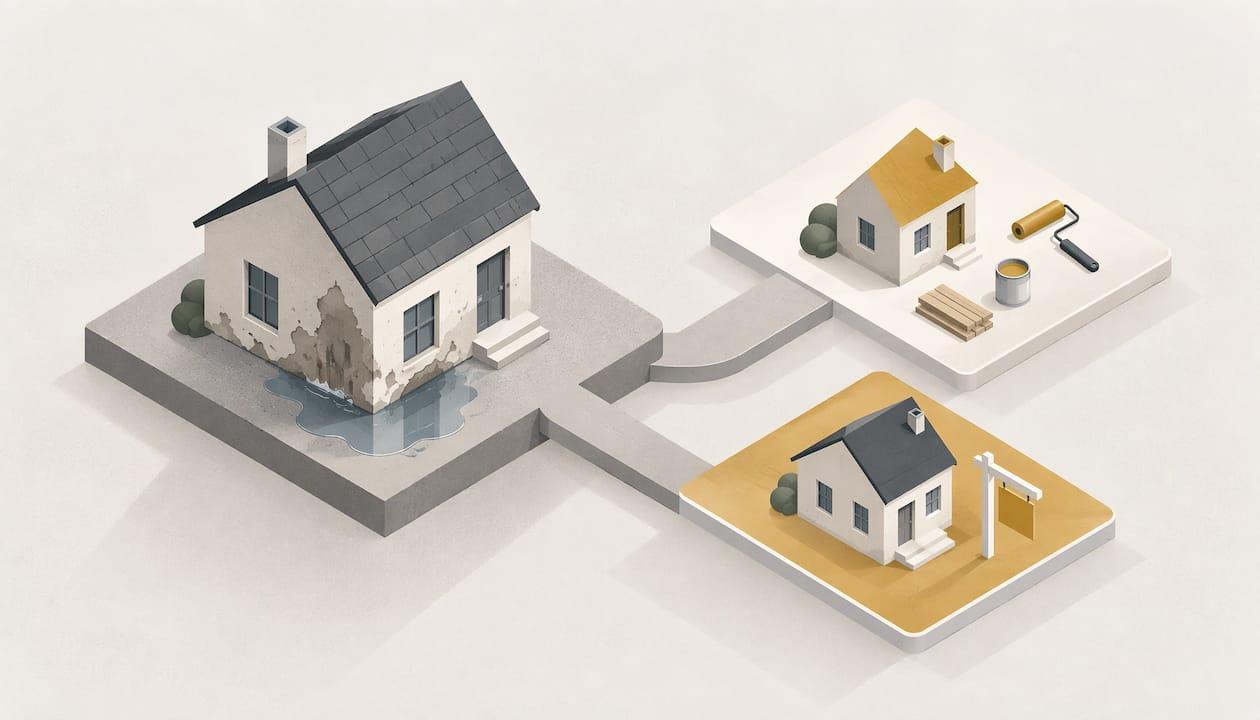
You can sell a water damaged house, and you do not have to repair it first. You have two real paths: fix it and list it, or sell it as-is to a buyer who takes it in its current condition. We buy houses in any condition in Houston, San Antonio, Dallas, and other U.S. markets. We make a cash offer within one business day, with no fees, no commissions, and no repairs on your side. Offers are subject to inspection and transaction requirements.
This guide covers what to do in the first days, what the damage does to value, what you must tell a buyer, and how to choose between repairing, listing, and selling directly.
TL;DR
- Water damage does not block a sale. It changes who your buyer is, how long the sale takes, and what the price looks like.
- Photograph and record everything before you clean, repair, or throw anything out. Mold can start forming within 24 to 48 hours.
- Disclose what you know. Rules differ by state, and the safest habit is to be honest and put it in writing.
- Repairing costs money and time up front. Selling as-is to a direct buyer skips repairs, showings, and agent commissions.
- Our cash offer comes within one business day, and closing can happen in as little as 7 days. Offers are subject to inspection and transaction requirements.
Table of Contents
- What water damage does to a sale
- Step 1: Protect people and the house
- Step 2: Document the damage before you touch it
- Step 3: Know what you have to disclose
- Step 4: Decide, repair, list, or sell as-is
- How much value does water damage take off?
- A repair-first plan, if you choose it
- Selling directly: what it looks like with us
- Get a cash offer on your water damaged house
- Our view: speed and certainty matter most
- Common mistakes with water damaged houses
- FAQ
- Sources
What water damage does to a sale
Buyers are afraid of what they cannot see. A stained ceiling might be a one-time roof leak. It might also be a slow plumbing problem that has rotted framing and grown mold inside the wall. A buyer who cannot tell the difference prices in the worst case.
That is why two houses with the same damage can sell very differently. The one with a clear record (cause found, source fixed, photos, invoices) gives a buyer something to hold onto. The one with a stain and no explanation gives a buyer room to negotiate hard, or walk.
A financed buyer adds another hurdle. Lenders order appraisals, and visible or documented water damage can pull value down, especially when structure or mold is involved. A deal can fall apart late in the process because the appraisal came in low or the repair list grew. A direct buyer who pays cash does not depend on a lender's appraisal.
Step 1: Protect people and the house
Before you think about selling, deal with the water.
- Stop the source. Shut off the main water line if a pipe broke. If the cause is storm flooding, wait until it is safe to re-enter.
- Stay safe. Do not enter a home with standing water near electrical outlets, or with a damaged structure.
- Start drying. Moving air and pulling out soaked materials matters because mold can begin forming within 24 to 48 hours of flooding, according to the National Flood Insurance Program.
- Call your insurer. Ask what your policy covers. The same NFIP page notes that mold damage is not covered under standard flood insurance policies, so find out early what your own policy says.
If you do not have the money or energy for drying and rebuilding, say so to yourself now. It affects which path makes sense.
Step 2: Document the damage before you touch it
Good records help in every scenario: an insurance claim, a repair sale, a disclosure form, or a direct sale.
The National Flood Insurance Program recommends photographing and videotaping damaged items before you clean, repair, or discard them. Take wide shots and close-ups of walls, floors, furniture, and structural damage.

For a more systematic record, the CDC's NIOSH built a Dampness and Mold Assessment Tool. It scores four categories: water damage or stains, visible mold, wet or damp materials, and mold odor. A score of 3 in any category signals that the source needs attention right away. A peer-reviewed NIOSH article explains that repeat assessments show whether damage is unchanged or getting worse, and that moisture sources should be found and repaired.
A simple record for each room should include:
- Date and what caused the water
- Photos and video, before any cleanup
- Where the damage is: ceiling, wall, floor, subfloor, crawlspace
- Any visible mold or musty smell
- Repair quotes or invoices, if you have them
- Insurance claim number and adjuster notes
Keep it in one folder. Whoever ends up buying, you will answer their questions faster.
Step 3: Know what you have to disclose
Disclosure is not something you can skip, and it is not the same everywhere. A RISMedia review of state rules found that states differ substantially. Some require detailed disclosure of flood damage, flood zone status, or disaster threats. Others have limited or vague requirements.
The habit that protects you in every state is simple: if you know about water damage, past flooding, leaks, or mold, write it down and give it to the buyer.
How long can a seller be held responsible afterward? It depends on the state and the facts:
- In Minnesota, a disclosure action must be brought within two years after closing, and seller liability requires knowledge of the issue.
- In Pennsylvania, an action under the Real Estate Seller Disclosure Law must generally be started within two years after final settlement, and other legal theories may carry different deadlines.
- In Indiana, a 2025 appellate decision in Orrico v. Snyder says liability under the state's seller-disclosure statute requires actual knowledge that a representation was false.
Three states, three different rules. For what applies to your property and your situation, talk to a real estate attorney licensed in your state before you sign a disclosure form or a contract.
Step 4: Decide, repair, list, or sell as-is
This is the real decision. Here is how the three routes compare.
| Repair, then list | List as-is with an agent | Sell directly to a cash home buyer | |
|---|---|---|---|
| Upfront cost | Contractor bills before you see a buyer | Little, but you may need to cover carrying costs | No repairs required |
| Showings and open houses | Yes | Yes | No |
| Agent commission | Typically 5% to 6%, negotiable | Typically 5% to 6%, negotiable | None with us |
| Depends on buyer's lender | Usually | Usually | No, cash |
| Time | Repairs plus market time | Market time, which can run long | Closing in as little as 7 days |
A conventional route has costs that do not show up on the sticker. U.S. News reports that in a balanced or buyer-leaning market, homes needing work can sell for 15% to 20% below market value, and that an as-is listing can sit longer, with mortgage payments, HOA fees, and utilities eating into what you keep.
The National Association of REALTORS® notes that a pre-sale inspection is optional. It does recommend getting repair estimates even if you do not plan to fix anything, because buyers may bring those costs up when they negotiate. That is a good reason to know your numbers in any scenario.
So who should repair first? A seller with cash, time, a stable timeline, and a market that rewards finished homes. Everyone else should look hard at selling directly. If the house has other problems on top of water damage, such as a cracked slab, see our guide on selling a house with foundation problems.
How much value does water damage take off?
Nobody can give you one number, because it depends on the cause, the extent, and the market. Research gives a sense of the scale for flooding.
A 2026 study in Economics of Disasters and Climate Change looked at Harris County, Texas after Hurricane Harvey. Flooded properties inside the 100-year floodplain sold at a discount of about 10.8% compared with properties that were not inundated and sat outside the Special Flood Hazard Area. The same study tied higher modeled flood probability to a further drop in sale price for flooded homes.
Separate research by Shr and Zipp found that housing values fall by more than 11% when a property is placed in a FEMA flood zone, and do not rebound when the designation is later removed.
What this means for you: the market attaches a discount to water history, and it can persist even after good repairs. A seller who spends heavily on repairs may not get that money back at closing. A direct sale lets you skip that bet.

A repair-first plan, if you choose it
Some owners want to fix the house and list it. If that is you, keep these in order:
- Fix the source first. Cosmetic repairs on a live leak just hide the problem.
- Get written quotes from licensed contractors. Keep invoices and permits.
- Have moisture readings taken after drying. Follow-up checks show whether the problem is gone or still active.
- Keep before-and-after photos. They go in your disclosure file.
- Price from comparable sales, not from your repair bill. Repair costs and sale price are separate numbers.
This route can work. It also takes weeks or months and real money before the first buyer walks in. If you are carrying a mortgage, those months are not free.
Selling directly: what it looks like with us
For many owners, the water is only part of the problem. The house may be vacant, inherited, tied up in a divorce, rented out to a bad tenant, or behind on payments. Paying for repairs on top of that is the last thing they need.
We buy houses in any condition, so a water damaged house is a house we can look at. Here is how it works:
- Tell us about the house. Share the address, what happened, and your timeline. Photos help.
- We make a cash offer within one business day. It is free and carries no obligation.
- Choose your closing date. Closing can happen in as little as 7 days, or later if you need time to move.
- Close with no fees and no commissions. You do not make repairs or clean out the house for us.
Offers are subject to inspection and transaction requirements, and we do not guarantee a price or a closing. What we do is give you a straight answer, quickly, from a real person, so you can compare it to the repair-and-list route with real numbers.
If your situation includes more than water, these guides may help:
- Behind on payments? Read can you sell your house if it's in foreclosure.
- Still paying a loan? See how to sell a house with a mortgage, including payoff and net proceeds.
- Inherited the house? Start with probate home sales.
- Is the property unsafe to occupy? Read about selling a condemned house.
- Need speed above all? See how to sell quickly, even in 7 days.
Get a cash offer on your water damaged house
Since 2015 we have bought over 200 homes. We buy in Houston, San Antonio, Dallas, and other U.S. markets, and we handle the legal work and paperwork in complex situations directly with you. You pay no fees or commissions, and you make no repairs.
To see what a sale would look like, request your free cash home offer. Houston owners can start from our Houston page. Offers are subject to inspection and transaction requirements.

If you have a flooded or leaking house in Texas, the local pages for Dallas and San Antonio list what we do in those markets.
Our view: speed and certainty matter most
We talk to owners of water damaged houses all the time, and the pattern is the same. The water is rarely the whole story. It arrives on top of a job change, a death in the family, a divorce, a tenant who stopped paying, or a mortgage that got behind.
In that situation, the usual advice is to repair, stage, list, and wait. That advice assumes you have cash for contractors, months of carrying costs, and the energy to host showings. A lot of owners have none of those.
So our approach is built to remove steps. We make a cash offer within one business day. We buy as-is, so you do not need to dry out, rebuild, or clean out the house for us. There are no fees and no commissions, and closing can happen in as little as 7 days when you need it to.
We would rather you make the decision with a clear number in your hand than a stack of contractor quotes and a guess at the market. Offers are subject to inspection and transaction requirements, and we say so up front. Ask us for the offer, compare it to your other options, and pick the one that gives you your life back.
Ammanuel
Common mistakes with water damaged houses
- Cleaning up before photographing. You lose the record you need for insurance and disclosure.
- Painting over stains. It does not fix the source, and you may still have to disclose what you know.
- Guessing at the cause. Find out whether it was a one-time event or an ongoing leak.
- Waiting while mold grows. Time makes the damage larger and the decision harder.
- Pricing from your repair bill. The market prices water history, not your invoices.
- Signing a disclosure you have not read. Rules vary by state, so ask an attorney in your state if you are unsure.
FAQ
Can I sell a house with water damage?
Yes. You can repair it and list it, list it as-is, or sell it directly to a cash home buyer. Whatever route you pick, disclose what you know about the damage.
Do home sellers have to disclose water damage?
In most cases, known water damage should be disclosed, but the exact rules depend on your state. Some states require detailed disclosure of flooding, and others are vague. A real estate attorney in your state can tell you what applies to your sale.
How much does water damage decrease home value?
It varies with the cause, the extent, and the local market. A 2026 study of Harris County, Texas found flooded homes inside the 100-year floodplain sold at a discount of about 10.8% after Hurricane Harvey. Your own number depends on your house, which is why a written offer helps you compare options.
How long am I liable for problems after selling?
It depends on the state. Minnesota and Pennsylvania, for example, generally allow disclosure claims within two years of closing, and liability usually turns on what the seller knew. Ask a local real estate attorney about your state's deadline.
Can Polus buy my water damaged house?
We buy houses in any condition in Houston, San Antonio, Dallas, and other U.S. markets. We make a cash offer within one business day, with no fees, commissions, or repairs required. Offers are subject to inspection and transaction requirements.
Sources
- Document Flood Damage, National Flood Insurance Program
- NIOSH Dampness and Mold Assessment Tool, General Buildings
- NIOSH Dampness and Mold Assessment Tool (DMAT), peer-reviewed article
- Flood and Disaster Disclosures, RISMedia
- Discovery of Hidden Defects in Your Newly Purchased Home
- Undisclosed Home Defects in Pennsylvania
- Orrico v. Snyder, Indiana Court of Appeals
- How Does Selling a House As-Is Work?, U.S. News
- Consumer Guide: Preparing to Sell Your Home, National Association of REALTORS®
- Flood Risk Discounts: Evidence from Housing Market, Springer
- The Aftermath of Flood Zone Remapping, Land Economics